“It’s Like a Vintage Bentley, Beautifully Restored.” David Briggs on Bristol Cathedral’s Renewed Organ
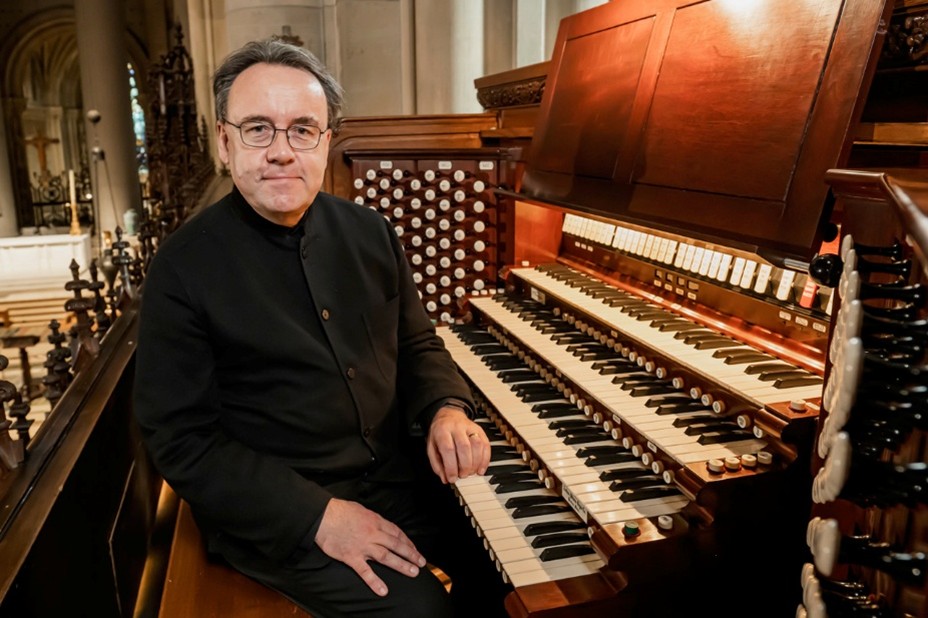
On 8th May, Bristol Cathedral welcomed more than 300 people for the Grand Organ Opening Recital performed by internationally acclaimed organist David Briggs, marking the return of the Cathedral’s historic organ following a major restoration by Harrison & Harrison.
Known worldwide for his virtuosic performances and extraordinary improvisations, David kindly granted Bristol Cathedral Trust an exclusive interview where he reflected on the restored instrument, the Cathedral’s remarkable acoustic sound, and why organs, such as the impressive instrument in Bristol, continue to inspire audiences today.
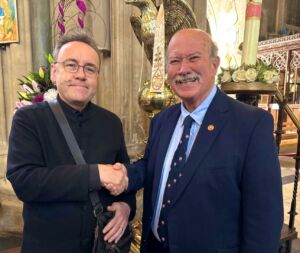
David Briggs with Stephen Parsons MBE DL, Chair of Trustees
Having performed on many of the world’s great cathedral organs, few musicians are better placed to assess the impact of such a restoration. In the following interview, David combines a performer’s insight with a deep understanding of organ building, acoustics and improvisation.
First impressions
David, you have played some of the world’s greatest cathedral organs. What was your immediate reaction when you first sat down at the restored Bristol Cathedral organ?
It was a little bit like being shown towards a vintage Bentley with eight cylinders, beautifully restored, with thick red carpet – the sort of Bentley where you climb into the back seat and sink into the creaking leather, and there’s that wonderful smell of old leather mixed with a little bit of petrol and exhaust fumes. There’s a walnut fascia, dials from the 1950s and a leather steering wheel. It all feels very aristocratic and wonderfully restored.
The organ has undergone a complete restoration and it’s the sort of instrument that affects the way you play because it has such a strong character all of its own. I suppose it’s a little bit like a good marriage! In a way it’s a kind of dichotomy between what you are as a musician and the experience you’ve had, but also, it’s got its own integrity and personality.
The organ is a great teacher, as long as you’re listening and have good technique. It truly was an honour for me to give this concert and I’m very conscious of that.
Was there a particular moment during the recital when you thought: “This instrument is truly back”?
All the time, really. It’s so good across the whole gamut of the repertoire. At the end of the concert, I improvised on a nursery rhyme, I think it was Mary Had a Little Lamb or something similar, and it’s very nourishing for the creative spirit because the instrument gives you so much back.
I particularly enjoyed playing the Bach Concerto because, for contrapuntal music and for Bach, it’s so alive. The choruses are so beautifully balanced.
Before the recital, the Music Assistant, Will, very kindly demonstrated some of the stop combinations I’d prepared. I walked down into the Nave to listen and thought: “This is like being in a great Austrian basilica.” The sound was incandescent, vibrant, alive and completely captivating.
The Bristol acoustic is really one of the best of any English cathedral. The resonance is beautifully even, and the acoustic adds so much to the organ.
One moment I’ll remember for a very long time was the slow movement of the Bach concerto. The stops I chose included the small open diapason and stopped diapason from the Great Organ, pipes dating back to the old Renatus Harris instrument. Those pipes have been in Bristol Cathedral since 1685.
That feels like one of those divine coincidences because 1685 was also the year Bach was born, and here I am, playing a Bach melody on pipes that have been in the Cathedral since the year of Bach’s birth. The sound was sweet, expressive, refined and utterly beautiful. That was certainly one of the high points of the concert for me.
The opening recital marked the return of the organ after almost two years of restoration. Did that sense of occasion affect the way you approached the performance?
I’ve played at Bristol quite a few times over the years. I was Organist of Truro for five years and then Gloucester for eight and a half, so I know and love the West Country.
The organ is colossally improved compared with what it was. I remember playing a concert in Bristol in the early 1990s after a previous restoration. The sound was magnificent, but the organ didn’t really do what your fingers told it to do. The pneumatic action from 1908 had been restored, and while it was noble and authentic, it felt a little bit like steering an old traction engine.
You knew it was the real thing. You knew the sound would be glorious when it eventually arrived. But it could be unpredictable and it didn’t repeat particularly well.
In fact, I remember preparing Marcel Dupré’s Deux Esquisses, which contains a lot of rapid repeated notes. The day before the concert I had to change the programme because the organ simply couldn’t play the piece. The action wasn’t quick enough.
The Cathedral’s decision to electrify the action has transformed that situation. The sound remains exactly the same, but now the organ responds properly.
What makes organists sound different from one another is often the touch. It’s similar to a Steinway piano. The speed of attack matters, but so does the speed of release. Those tiny differences in touch are part of a musician’s personality.
Now the organ responds immediately to those nuances, and that makes an enormous difference.
Approaching the opening recital, it was simply heartening to hear the sound and know that the instrument was responding exactly as it should.
How different did the organ feel physically and musically after the refurbishment?
Harrison & Harrison are the gold standard. They always have been. The instrument is beautifully voiced, beautifully regulated and wonderfully consistent. There are no surprises.
What I remember most from the previous incarnation of the organ is its immense poetry. The softer sounds were always magical, helped enormously by the Cathedral acoustic, which creates a sort of halo around the sound.
And then, when you turn the power up… When you engage the overdrive in fifth gear and start worrying about seeing flashing lights in the rear-view mirror, it’s absolutely thrilling.
The reeds are incredible. It’s a little bit like cooking with a frying pan that’s just a bit too hot and has a lid on it. You lift the lid at your peril!
What moved me most after the recital was meeting people who were genuinely inspired by what they had heard.
In truth, my life’s mission is to introduce as many people as possible to the pipe organ. Most simply don’t realise how extraordinary it is or what effect it can have on your insides. It’s the best instrument. There’s nothing quite like it.
The instrument itself
Organ restoration combines engineering and artistry. What details did you notice that many listeners might not immediately appreciate?
The main thing about performance is the relationship between player and listener. You’re always acting as an ambassador for the composer, and the composer should be paramount.
After a concert, I hope people leave saying, “That Bach was incredible,” or “That Dupré was extraordinary.” They should be talking about the music.
The performer is important, of course, but only as part of an equilateral triangle between composer, performer and audience.
Now that the organ is in such good condition, it becomes possible to represent the composer’s intentions much more faithfully. You don’t have to alter musical decisions because of technical limitations.
The other thing people don’t always appreciate is the impact of modern console technology. There is no computer-generated sound, let’s be absolutely clear about that, but the control systems have become extraordinarily sophisticated.
You now have huge numbers of pre-set combinations available, allowing you to shape colour and texture with incredible flexibility.
That’s why I arrived two days before the recital at Bristol Cathedral. You’re effectively ‘cooking’.
You listen, you adjust, you add a little more of this, a little less of that. Like herbs and ingredients in a recipe, you’re blending sounds until the organ says exactly what you want it to say as a musician.
The technology is a genuine game changer.
Many audience members praised the live video relay showing your hands and feet. Is that something you often use?
Increasingly, yes. The important thing is that it has to be wired rather than wireless. Even a tenth of a second of delay is horrible both for the performer and the audience.
But when it works properly it’s fantastic because people gain an insight into the physicality of organ playing. You’re using all four limbs.
One lady came up to me after the concert and said she had no idea feet could move so fast.
I said, “Madam, if you’re ever invited to dance with me, definitely say no.”
I’m probably the world’s worst dancer. My sense of rhythm off the organ is lamentable. But I can move fast on the pedals.
The screens remind me of flying before 9/11. On transatlantic flights I would always ask if I could visit the flight deck. It was absolutely thrilling.
The video screens are the equivalent of that. They allow audiences to come up front and see the action. After all, if you went to the Royal Albert Hall, you wouldn’t hide the pianist behind a curtain. The screens help draw people into the performance, and that’s enormously valuable.
The programme spanned several centuries of music. Did certain repertoire particularly suit the renewed sound of the instrument?
The remarkable thing is that the organ plays everything well. It’s marvellous in Bach because the principal choruses are so beautifully constructed and balanced.
You can hear the counterpoint with extraordinary clarity. Harmony is the vertical aspect of music, the notes stacked on top of one another, but counterpoint is the conversation between different voices.
On the Bristol organ, those voices emerge so clearly that you can almost imagine four separate musicians performing them. That’s the mark of a truly distinguished instrument.
There are also strong family resemblances to other Walker organs I’ve played, particularly Sacred Heart, Wimbledon. In some ways it feels like a cousin.
The advantage now is that all that character remains, but with far greater reliability and significantly lower maintenance requirements.
Performance and improvisation
You are renowned for improvisation. Does playing a newly restored organ change the way you improvise?
Yes, absolutely. Improvisation is very much about your relationship with the instrument.
If the instrument is functioning beautifully, it gives you more back and you don’t have to make decisions based on its quirks.
The Bristol organ has always had tremendous character. What the restoration has done is unleash that character in a much more precise way.
I loved improvising during the recital, and also during The Phantom of the Opera, which I performed at Bristol Cathedral the following evening.
Improvising for silent film is like creating a film score in real time. You have all the colours of a symphony orchestra available to you, plus those subterranean growls from the 32-foot pipes and the great reeds. It’s enormous fun.
It’s a bit like being a painter with a vast palette of colours. You can use them individually or blend them together. The pipework at Bristol is of such quality that the blending of colours is particularly inspiring.
Your performances often feel orchestral in colour and texture. Did the refurbishment open up new possibilities in that respect?
Absolutely. One important development involves the couplers.
Without couplers, you play a note and hear that note. With octave and sub-octave couplers, the organ automatically adds pitches above and below, dramatically expanding the tonal palette. It’s almost like tripling your available colours.
From memory, the Solo Organ didn’t previously have some of these possibilities. Electrification has significantly expanded the colouristic capabilities of the instrument.
As you have just mentioned, the following evening you improvised a live score to The Phantom of the Opera. What makes cathedral organs so effective for silent film accompaniment?
It’s the combination of colour, acoustic and environment. You’re taking a visual artwork created nearly a century ago and fusing it with music that exists only in that moment.
That’s the word: fusion. The music is ephemeral. It’s spontaneous. Once it’s happened, it’s gone.
Bristol was actually my 292nd performance of Phantom. The first was in 1995 and I still perform around ten each year. I’ll let you into a secret: I’ve never seen anybody else accompany it. I have absolutely no idea what anyone else does. Maybe one day I’ll find out, but for now I just paddle my own canoe as fast as I can, and people seem to like it.
The future of organ music
For people hearing a cathedral organ for the first time, what do you hope they experience?
The primary goal is simple: to move people. That’s the most important thing.
I often introduce school groups to the pipe organ and they’re fascinated by the technology: the four keyboards, the stops, the pedals, the electronics and all the mechanisms. But what really strikes you is the wonder in their eyes.
Fewer and fewer people hear organs regularly these days, so for many children this is their first encounter with the instrument. There’s nothing quite like it. It’s like hearing a full symphony orchestra in a magnificent acoustic, surrounded by beautiful architecture. Watching people’s reactions to that experience is one of the greatest pleasures of the job.
What role do events such as Bristol Cathedral’s Grand Organ Festival play in introducing new audiences to organ music?
They’re hugely important. The quality of the publicity surrounding the festival has been exceptional. The brochure, social media and wider promotion all help bring the organ into public view.
Social media has become incredibly important. Since the pandemic, I’ve produced a new video for YouTube and Facebook every week, handling everything myself – the cameras, sound recording and editing. It’s all been learned through trial and error, but I really enjoy it. Some of those videos attract 15,000 views or more.
For students, YouTube is also a fantastic resource. If you’re studying French organ music, you can watch Daniel Roth at Saint-Sulpice or Olivier Latry at Notre-Dame and immerse yourself completely in that musical world.
Social media and publicity matter enormously – provided the product itself is good.
Historic organs carry centuries of craftsmanship and musical heritage. Why are they worth preserving, even when restoration is such a major undertaking?
Because they sound so beautiful. There’s something extraordinary about pressing a key and hearing pipes that were made in 1685 and still sound very much as they did then.
The Harrison & Harrison team are such experts that I’m convinced those historic Bristol pipes sound very close to what they would have sounded like when they were new.
I spend a lot of time playing historic organs in Germany and the Netherlands. Those instruments are wonderful teachers, both in how they sound and how they feel. Playing one is a bit like being loaned a Stradivarius. The instrument itself influences how you think, how you play and how you express the music.
The question of how far restoration should go is always a complicated one. Should you preserve historic mechanisms exactly as they were? That’s a debate with many viewpoints. But in Bristol’s case, the original 1908 pneumatic action simply wasn’t functioning reliably enough.
It was a little like driving a car and not being entirely sure whether it was going to get you where you wanted to go. Now that uncertainty has disappeared. The sound remains the same, but the instrument works properly.
Ultimately, our responsibility is to put the music first. We want instruments that allow great music to speak clearly, and Bristol Cathedral now has exactly that.
Bristol Cathedral Trust is enormously grateful to David for granting us this fascinating interview. To follow David on social media, you can find him on YouTube and Facebook. You can also order a copy of David’s memoir, Pipes & Passions, via his website: www.david-briggs.org.
Thank you also to the many generous donors who made this phenomenal restoration work possible, especially the Harry Crook Foundation, the Nisbet Trust and the Society of Merchant Venturers.